Talk by Jackie Marsh on 19 November 2024. Review by Marlene
As a Brighton resident, a graduate in the History of Decorative Arts and Crafts at Brighton University, where she also teaches now, and a guide at the Royal Pavilion, Jackie Marsh Hobbs was well-placed to give her audience an in-depth insight into both the background of the building and the character of its first owner.
She presented a number of images to illustrate her talk, the first of which was a portrait by Sir Joshua Reynolds of the future George IV, then still Prince of Wales. Another image, of Brighton at that time, highlighted where the Royal Pavilion was to be built, in an area already covered in buildings.
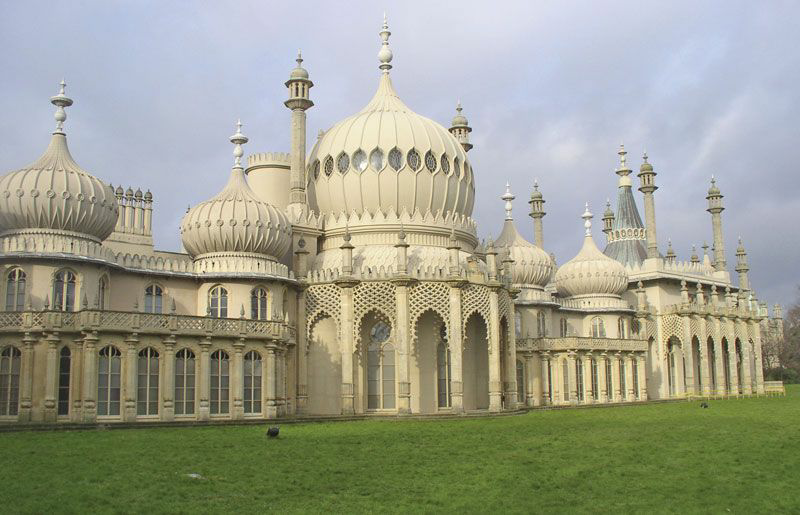
We learned that Prince George initially rented a house in Brighton, but this proved to be too small as he liked to entertain lavishly. A further image showed his new building, designed by architect Henry Holland in 1787. This became the wing on the left side when another wing and a dome was added later (by architect John Nash). The building nearby, now known as the Dome, predates the final Pavilion structure. Built in 1808 and copied from Indian architecture, it was created out of cast iron and glass to provide better accommodation for his horses.
George became the Regent for his father from 1811 until 1820, then king in his own right from 1820 to 1830. As Regent he was not universally popular, due to his overindulgent lifestyle. Criticism of the time was illustrated by a cartoon which exaggerated the number of minarets of the Pavilion and the clothing of the people walking there. Hand-tinted images of the Royal Pavilion were commissioned then, and these were used in the present day to restore parts of the building.
In 1821, a tunnel was created to go under the gardens to the bottom of the Dome. The purpose was to give private access to the horses for riding, not, as is popularly thought, for visiting Mrs Fitzherbert or other ladies in secret.
Our speaker outlined the background of the royal succession priorities for George IV and some of the scandals. The liaison with Mrs Fitzherbert ( a staunch Roman Catholic and a commoner) made any formal commitment illegal. His marriage to Caroline of Brunswick whom he met three days before the wedding was a disaster but resulted in the birth of his daughter Charlotte. She married Leopold of Saxe-Coburg but sadly died in child-birth, so the succession went to his brother William (who had no legal issue), and eventually to his niece, Victoria.
At this point we learned of the second phase of the Royal Pavilion’s history. Victoria liked the Royal Pavilion at first, making several visits, but decided its location in Brighton was insufficiently private and the garden space too restricted. In this phase, all the furnishings were removed to Buckingham Palace, only two fireplaces remained. It was decided to sell the building to the Brighton town council, and this was the start of its new role as an events venue. In World War 1, it was converted into a hospital for Indian troops. Sporadic restoration was carried out after this, but then it was used during World War 2 as an air raid shelter, for making ration books and for holding balls. The gardens became allotments and pigs were kept there as well
Further restoration work started to be carried out after the war, despite setbacks caused by an arson attack and by damage in the 1987 storm. When a new wing for Buckingham Palace was being created, former Pavilion furnishings were returned on loan then, and Queen Elizabeth made subsequent loans to help the refurbishment of the exotic interiors.
Towards the end of her talk, our speaker showed a number of images, which included some of the restored rooms, secret staircases, the old Indian Gate and the new (paid by India and designed by an Indian architect as thanks for the Indian soldiers’ hospital) and modern light displays, and explained that funding now comes under a non-profit making Trust.
As always, we have had a very interesting talk and, as it is about one of our more local attractions, we have no doubt been inspired to visit, or revisit, the Royal Pavilion in the near future. Our thanks to our speaker, Jackie Marsh Hobbs.